How to Get the Best Out of Google Ad Grants: A Complete Guide for Nonprofits

Updated: Aug 27

Most nonprofits think Google Ad Grants are about free advertising. They are not.
Google Ad Grants is one of the most valuable digital resources available to eligible nonprofits. Through the programme, Google provides up to US$10,000 (approximately ₹8–9 lakh) every month in Google Search advertising to help nonprofits attract donors, volunteers, beneficiaries, partners and supporters.
Yet, many organisations never fully utilise the grant.
Some struggle to spend even a small portion of the monthly budget. Others generate website traffic but fail to convert visitors into volunteers, donors or programme participants.Google Ads can only perform as well as the systems supporting them.
To maximise the value of Google Ad Grants, nonprofits need a strong digital foundation. This guide explains the seven pillars every nonprofit should have in place before expecting meaningful results.
So, What Does Google Ads Grants Actually Do for a Nonprofit?
At this point, you may be wondering:
“This sounds valuable, but will Google Ad Grants actually make a difference to our organisation?”
That's the right question.
Google Ad Grants should not be treated as another digital tool that an organisation activates simply because it is free. It becomes valuable when it is connected to clear organisational goals.
The real opportunity is not the $10,000/month advertising credit itself.
The opportunity is the ability to consistently put your organisation in front of people who are already searching for the issues, programmes, services, causes and opportunities connected to your work.
From advertising budget to organisational outcomes
A well-managed Google Ad Grant can become a channel for generating:
More visibility
More people discover your organisation, programmes, research, campaigns and work.
More supporters
People interested in your cause can discover ways to donate, volunteer, participate or support your work.
More programme participation
People searching for relevant services, programmes or opportunities can be directed to the right information.
More fundraising opportunities
Your organisation can reach people actively searching for causes and organisations they may want to support.
More partnerships
Greater visibility can help CSR teams, institutions, researchers and other stakeholders discover your work.
More engagement
Instead of simply increasing website traffic, campaigns can encourage meaningful actions such as registrations, enquiries, downloads, subscriptions and applications.
The important distinction is this:
Google Ads Grant should not be measured by how much advertising you receive. It should be measured by what that advertising helps your organisation achieve.
Is Google Ad Grants another liability?
It can be—if it is treated as a standalone activity.
If an organisation launches a few advertisements, sends everyone to its homepage, does not track conversions, and never reviews campaign performance, the grant can become another account that someone has to maintain without producing much value.
But when the grant is connected to organisational priorities, the picture changes.
For example:
Organisational Goal | How Google Ads Grants Can Support It |
Recruit volunteers | Reach people searching for volunteering opportunities |
Increase donations | Reach people searching for relevant causes and ways to contribute |
Promote a programme | Direct relevant searches to programme-specific pages |
Attract interns | Reach students and young people searching for opportunities |
Promote research | Increase discovery of reports, research and publications |
Build awareness | Reach people searching for information related to your area of work |
Generate enquiries | Bring relevant visitors to pages designed to encourage contact |
Strengthen partnerships | Increase visibility among organisations and stakeholders searching for your area of expertise |
The real value is the system you build around the grant
Google provides the advertising opportunity.
Your organisation provides the mission, programmes, stories, expertise and calls to action.
Your website provides the destination.
Conversion tracking tells you what people actually do.
And ongoing optimisation improves the system over time.
This creates a simple growth cycle:
Google Search → Relevant Visitor → Website → Meaningful Action → Measurable Outcome → Optimisation
Over time, this can become a repeatable digital channel for your organisation—not just a one-time advertising opportunity.
Should every nonprofit invest time in Google Ad Grant?
Not necessarily.
Google Ad Grants is most valuable when an organisation:
Has clear organisational priorities
Has a credible and functional website
Has programmes, campaigns or resources it wants more people to discover
Can respond to enquiries, registrations or other actions generated through the website
Is willing to measure results
Has someone responsible for managing the programme or a partner who can manage it
If these foundations are missing, the first priority may be to strengthen them.
But if your organisation already has a strong foundation, not using Google Ad Grants can mean leaving a significant source of digital visibility unused.
To find out if your nonprofit is ready for Google Ad Grants, take the Ad Grant Readiness Assessment. It’ll show you where you currently stand and, more importantly, what actions you need to take next.
The question to ask is not “Can we use the grant?”
The better question is:
“What could our organisation achieve if we consistently reached more of the right people every month?”
That is the real potential of Google Ad Grants.
The grant provides the opportunity. Strategy, content, website readiness, measurement and ongoing optimisation determine how much value your organisation gets from it.
The Google Ad Grants Readiness Framework
At Arcucom, we believe successful Google Ad Grants management depends on seven interconnected pillars.
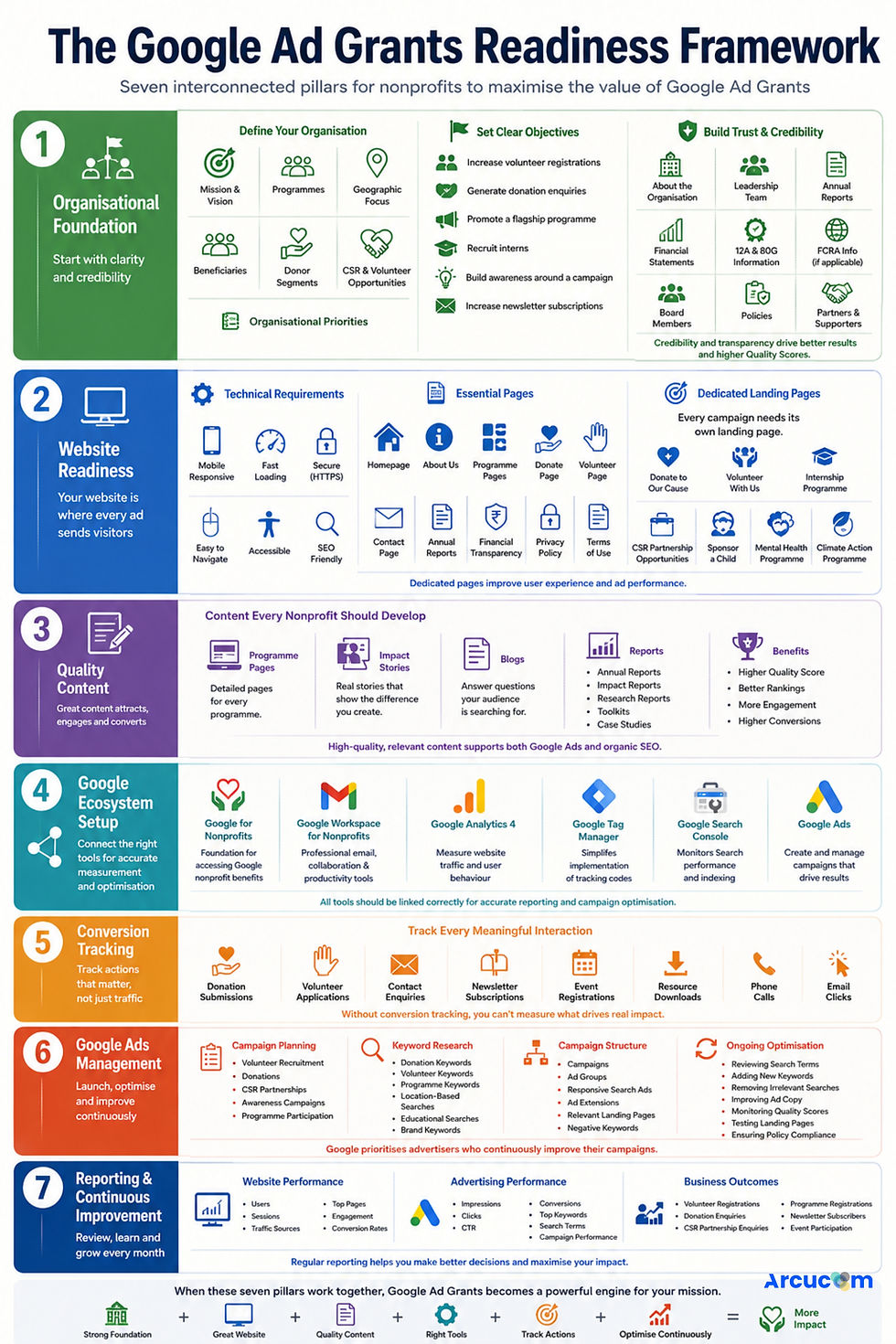
1. Organisational Foundation
Every successful advertising campaign begins with clarity.
Before running Google Ads, a nonprofit should clearly define:
Its mission and vision
Programme areas
Geographic focus
Target beneficiaries
Donor segments
Volunteer opportunities
CSR partnership opportunities
Organisational priorities
Define clear objectives such as:
Increase volunteer registrations
Generate donation enquiries
Promote a flagship programme
Recruit interns
Build awareness around a campaign
Increase newsletter subscriptions
The more focused the objective, the better the campaign performs.
Your website should clearly communicate:
About the organisation
Leadership team
Annual reports
Financial statements
12A and 80G information
FCRA information (where applicable)
Board members
Policies
Partners and supporters
Google also rewards websites that demonstrate credibility and transparency.
2. Website Readiness
Your website is where every advertisement sends visitors.
If the website is slow, confusing or outdated, advertising performance suffers regardless of how good the campaigns are.
Technical Requirements
Your website should be:
Mobile responsive
Fast loading
Secure (HTTPS)
Easy to navigate
Accessible
Search engine friendly
Essential Pages
Every nonprofit’s website should have:
Homepage
About Us
Programme pages
Donate page
Volunteer page
Contact page
Annual Reports
Financial Transparency
Privacy Policy
Terms of Use
Dedicated Landing Pages
One of the biggest mistakes nonprofits make is sending all traffic to the homepage.
Instead, every campaign should have its own landing page.
Examples include:
Donate to Our Cause
Volunteer With Us
Internship Programme
CSR Partnership Opportunities
Sponsor a Child
Mental Health Programme
Climate Action Programme
Dedicated landing pages improve both user experience and Google Ads performance.
3. Quality Content
Google rewards relevant and useful content.
Advertising cannot compensate for poor content.
Strong content improves:
Quality Score
Search rankings
User engagement
Conversion rates
Content Every Nonprofit Should Develop
Programme Pages
Every programme deserves its own page.
Instead of listing all initiatives on one page, create detailed pages for each programme.
Impact Stories
Share real stories that demonstrate the difference your organisation creates.
Blogs
Publish articles that answer questions your audience is already searching for.
Examples:
How to volunteer with an NGO
Understanding child malnutrition
What is CSR under the Companies Act?
How individual donors can create impact
Reports
Include:
Annual Reports
Impact Reports
Research Reports
Toolkits
Case Studies
High-quality content supports both Google Ads and organic SEO.
4. Google Ecosystem Setup
Google Ad Grants works best for nonprofits when following tools are properly configured and connected -
Google for Nonprofits
This is the foundation for accessing Google's nonprofit benefits.
Google Workspace for Nonprofits
Provides professional email, collaboration and cloud productivity tools.
Google Analytics 4
Measures website traffic and user behaviour.
Google Tag Manager
Simplifies implementation of tracking codes.
Google Search Console
Monitors search performance and indexing.
Google Ads
The advertising platform where campaigns are created and managed.
All of these tools should be linked correctly to ensure accurate reporting and campaign optimisation.
5. Conversion Tracking
Many nonprofits celebrate website traffic.
Traffic alone creates very little value.
What matters is action.
Every meaningful interaction should be measured.
Good website traffic in itself is not enough to achieve the goals. The website should measure every meaningful interaction.
For example:
Donation submissions
Volunteer applications
Contact enquiries
Newsletter subscriptions
Event registrations
Resource downloads
Phone calls
Email clicks
Without conversion tracking, it becomes impossible to understand which campaigns are delivering results.
6. Google Ads Management
Once the foundations are in place, campaigns can be launched.
Successful Google Ad Grants management includes far more than creating advertisements.
It requires continuous optimisation.
Campaign Planning
Campaigns should align with organisational objectives.
Examples:
Volunteer Recruitment
Donations
CSR Partnerships
Awareness Campaigns
Programme Participation
Keyword Research
Identify what people are actually searching for.
Keyword research should include:
Donation keywords
Volunteer keywords
Programme-specific keywords
Location-based searches
Educational searches
Brand keywords
Campaign Structure
Each campaign should include:
Campaigns
Ad Groups
Responsive Search Ads
Ad Extensions
Relevant Landing Pages
Negative Keywords
Ongoing Optimisation
Google Ad Grants requires regular management.
Activities include:
Reviewing search terms
Adding new keywords
Removing irrelevant searches
Improving ad copy
Monitoring Quality Scores
Testing landing pages
Ensuring Google policy compliance
Google prioritises advertisers who continuously improve their campaigns.
7. Reporting and Continuous Improvement
Google Ad Grants should be managed as an ongoing growth programme, rather than a one-time setup.
Every month, organisations should review:
Website Performance
Users
Sessions
Traffic sources
Top-performing pages
Engagement
Conversion rates
Advertising Performance
Impressions
Clicks
Click-through Rate (CTR)
Conversions
Top-performing keywords
Search terms
Campaign performance
Business Outcomes
Ultimately, success should be measured by organisational impact.
Examples include:
Volunteer registrations
Donation enquiries
CSR partnership enquiries
Programme registrations
Newsletter subscribers
Event participation
Regular reporting helps organisations make better decisions and continuously improve campaign performance.
Common Mistakes Nonprofits Make
Many organisations fail to realise the full value of Google Ad Grants because they:
Treat it as a one-time setup instead of an ongoing programme.
Send all advertisements to the homepage.
Have weak or outdated website content.
Don't measure conversions.
Ignore search engine optimisation.
Fail to create dedicated landing pages.
Do not optimise campaigns regularly.
Focus only on traffic instead of meaningful outcomes.
Avoiding these mistakes significantly increases the likelihood of long-term success.
A Better Way to Think About Google Ad Grants
It is more than free advertising. When implemented correctly, it helps nonprofits to:
Increase visibility
Reach new donors
Recruit volunteers
Promote programmes
Strengthen credibility
Build long-term digital assets
Improve fundraising readiness
The grant works best when combined with a strong website, compelling content, robust analytics, and a clear communications strategy.
How Arcucom Helps
At Arcucom, we work with nonprofits across three main pillars - foundations and systems, programmes, and strategic communications under the ARC Programme to make organisations credible, fundable, and visible.
For long-term growth, we strengthen the nonprofits’ foundation with evidence-led strategies, and build a digital foundation to make Google Ad Grants effective beyond just running advertisements.
For a robust digital system, we support with -
Implementing Google for Nonprofits
Google Workspace setup and migration
Google Ad Grants activation
Website readiness assessment
Keyword research and campaign strategy
Landing page recommendations
Google Analytics and conversion tracking
Ongoing campaign management and optimisation
Monthly reporting and strategic recommendations
If your organisation is considering Google Ad Grants or wants to improve the performance of an existing account, we'd be happy to assess your current readiness and recommend the next steps.
Take Action Now:
Google ad grant assessment
Check whether you are ready to implement google ad grant.
Book a call with an Expert
Discuss how we can help you get the best out of Google ad Grant.
